The cell receives mRNA.
I used synthetic mRNA encoding RNJ1, an antibody that recognises tau. In the cytoplasm, the cell’s protein-making machinery reads this mRNA.
I investigate how cells can produce therapeutic antibodies from mRNA, and how to deliver that mRNA to the brain.
My PhD at The Florey and the University of Melbourne focuses on lipid-based carriers for mRNA delivery. My earlier work tested whether mRNA-encoded antibodies could bind tau in human cells.
In my first-author study, we used mRNA to produce antibodies that recognise tau, a protein that clumps into toxic aggregates in Alzheimer’s disease. The animation shows how the intracellular antibody fragment is made and binds tau.
See the cell experiments ↓Illustrated RNJ1 scFv mechanism in human SH-SY5Y cells. Our findings are in Brain Communications (2024).
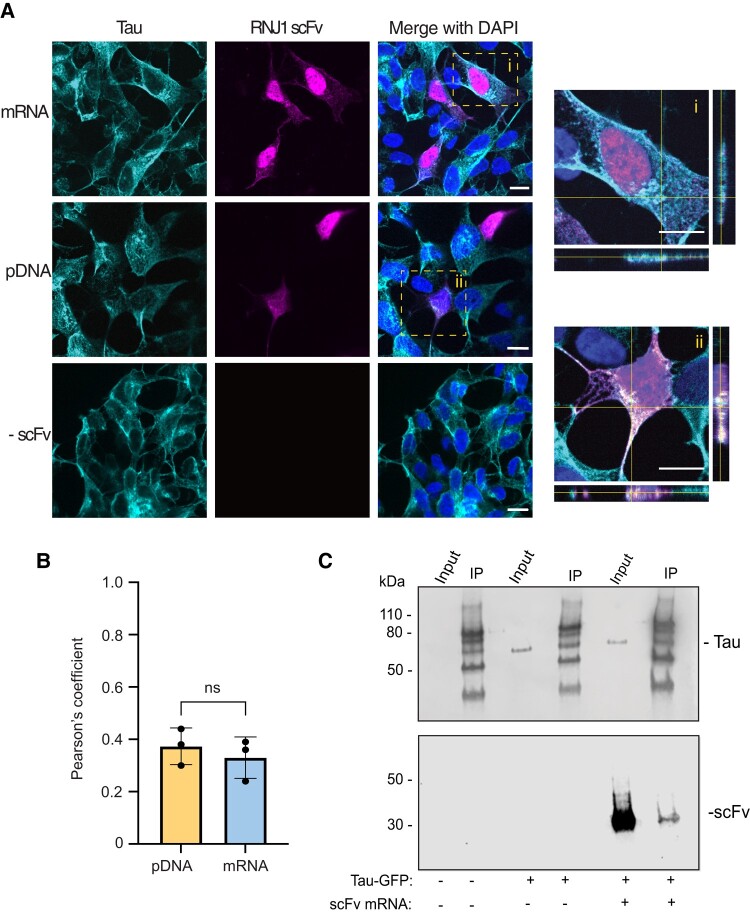
We used fluorescence microscopy to compare antibody fragment expression following mRNA and plasmid DNA delivery in neuron-like cells.
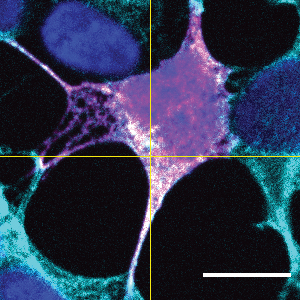
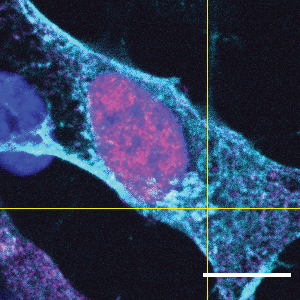
Following mRNA delivery, our antibody fragment was successfully expressed in the cytoplasm and nuclei of neuron-like cells. Our Z-stack analysis also revealed co-localization with its target, tau.
Human tau-GFP SH-SY5Y cells. Nuclei stained with DAPI. Original published images and scale bars.
Brain Communications (2024), Figure 5A. Full Figure 5 Paper & methods
We expressed RNJ1 scFv from mRNA. Tau and the antibody fragment appear within the same cells.
mRNA delivery to the brain
I investigate lipid-based carriers to improve delivery of antibody-encoding mRNA to the brain. This builds on my earlier work in mRNA synthesis and extracellular-vesicle delivery.
In the lab, I produce mRNA, synthesise and analyse nanoparticles, culture cells, and measure protein expression and target engagement.
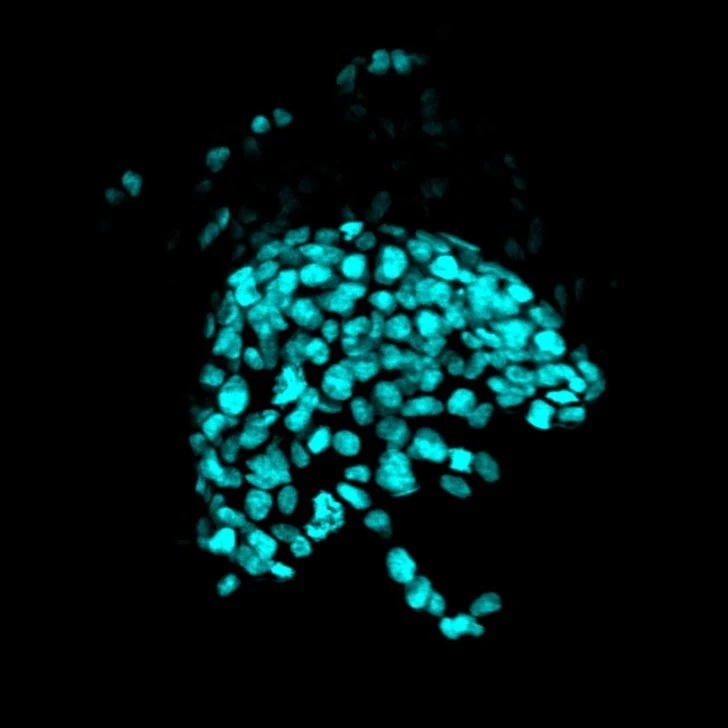
Dementia Umbrella. My micrograph of human brain cancer cells used in dementia research, in The Florey Neuropix collection.
Brain Communications · 2024
In my first-author study, we used synthetic mRNA to express RNJ1 as a secreted antibody and an intracellular fragment, and demonstrated tau engagement in human cells.
Journal of Extracellular Biology · 2024
I co-authored this study of metals in small extracellular vesicles. We found that these vesicles contain essential and non-essential metals and can transfer metal between cells.