The cell receives mRNA.
I used synthetic mRNA encoding RNJ1, an antibody that recognises tau. In the cytoplasm, the cell’s protein-making machinery reads this mRNA.
PhD candidate
The Florey · The University of Melbourne
My research explores mRNA-encoded antibodies as an alternative means to deliver antibodies for Alzheimer’s disease. I am dedicated to improving patient outcomes and treatment accessibility.
In my PhD, I’m developing brain delivery vehicles to enhance the uptake of mRNA-encoded antibodies in the brain for Alzheimer’s disease.
In my first-author study, we used mRNA to produce antibodies that recognise tau, a protein that clumps into toxic aggregates in Alzheimer’s disease. The animation shows how the mRNA-encoded antibody fragment is made intracellularly and engages with tau.
See the cell experiments ↓Illustrated RNJ1 scFv mechanism in human SH-SY5Y cells. Our findings are in Brain Communications (2024).
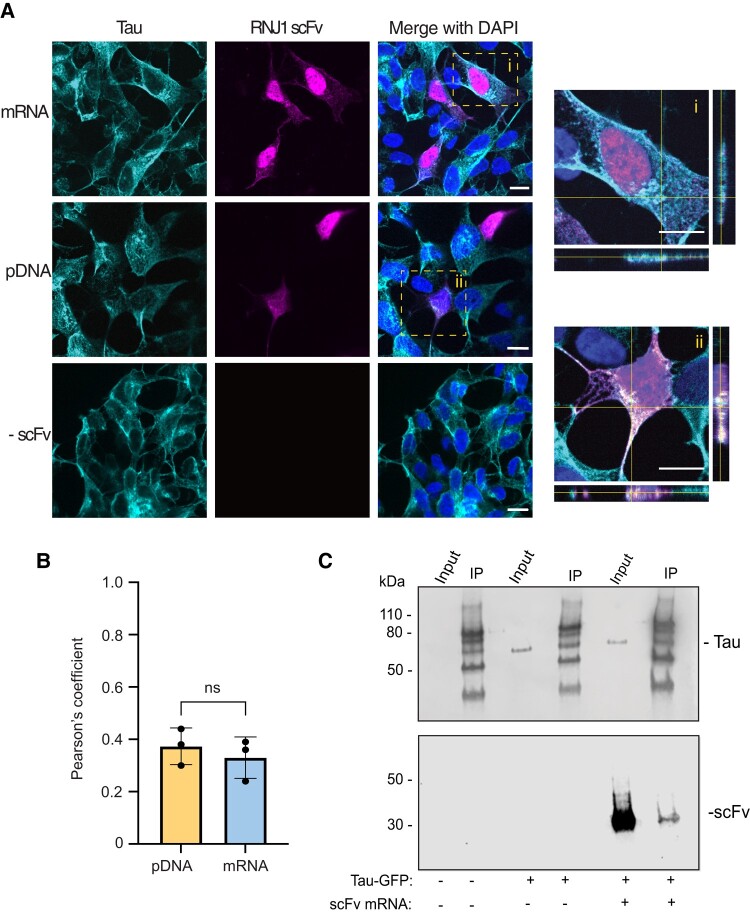
We used fluorescence microscopy to compare antibody fragment expression following mRNA and plasmid DNA delivery in neuron-like cells.
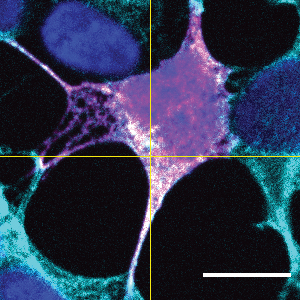
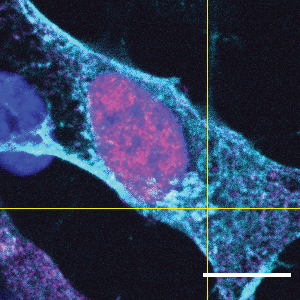
Following mRNA delivery, our antibody fragment was successfully expressed in the cytoplasm and nuclei of neuron-like cells. Our Z-stack analysis also revealed co-localization with its target, tau.
Human tau-GFP SH-SY5Y cells. Nuclei stained with DAPI. Original published images and scale bars.
Brain Communications (2024), Figure 5A. Full Figure 5 Paper & methods
We expressed RNJ1 scFv from mRNA. Tau and the antibody fragment appear within the same cells.
Brain Communications · 2024 · First author
In my first-author study, we used synthetic mRNA to express the anti-tau antibody RNJ1 as both a secreted antibody and an intracellular fragment, demonstrating target engagement in human cells.
Read paperJournal of Extracellular Biology · 2024 · Co-author
I co-authored this study of metals in small extracellular vesicles. We found that these vesicles contain essential and non-essential metals and can transfer metal between cells.
Read paper
My grandmother and great-aunt were both affected by Alzheimer's disease, and I witnessed firsthand the devastating impact it can have on those we love. Their experiences have deeply shaped my motivation to pursue Alzheimer's research. In honour of their legacies, I am driven to contribute to the development of novel therapeutics for Alzheimer's disease in the Antibody Therapeutics Group at The Florey, under the guidance of my supervisors, A/Prof Rebecca Nisbet and A/Prof Laura Vella.